Over-the-Range Microwave Dimensions Standard
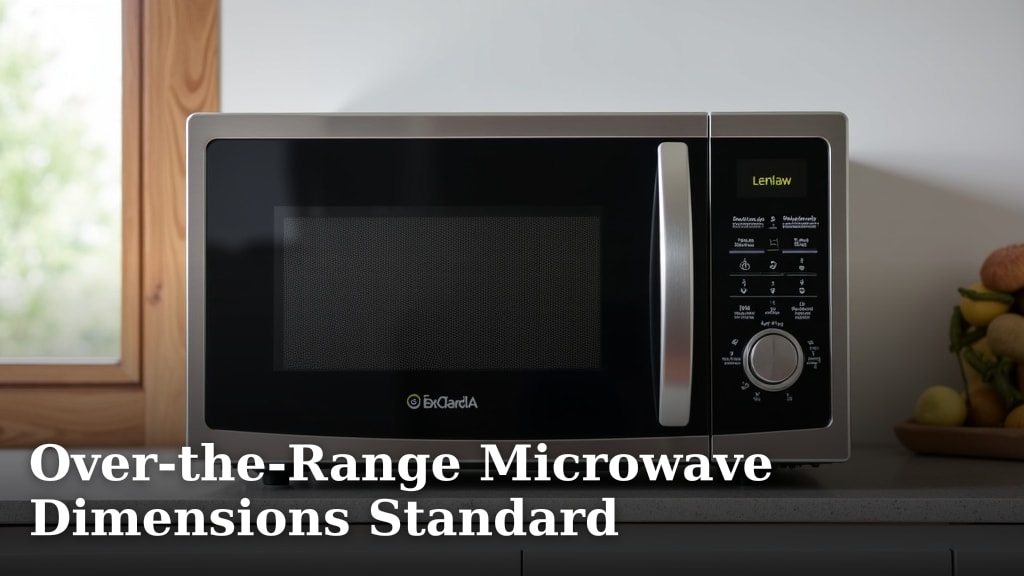
Over-the-range microwave dimensions are fairly standard, but variations exist. Most units measure around 30 inches wide. This is the most common size for fitting above most standard stovetops. Always double-check the exact measurements before buying.
When looking at over-the-range microwaves, consider the height and depth too. These dimensions ensure a proper fit in your kitchen space. You’ll want to make sure there’s enough clearance for the door to open fully. Think about the space above and around the microwave.
- Standard width is usually 30 inches.
- Check height and depth for your specific cabinet space.
- Ensure door clearance for easy use.
- Variations do exist, so measure carefully!
Let’s walk through exactly what dimensions you need to know and how they impact your kitchen setup.
Understanding Over-the-Range Microwave Sizes
When you’re looking to buy a new over-the-range microwave, the dimensions are probably one of the first things on your mind. You want it to fit perfectly above your stove, right? We found that most over-the-range microwaves are designed with a standard width. This makes the shopping process a bit easier, as you have a good starting point.
The goal is to ensure your new microwave doesn’t just fit, but also looks like it belongs. Think of it like buying a piece of furniture for your kitchen. You need to know the space you have available. We’ve seen many shoppers get excited about a microwave’s features, only to realize it’s too wide or too tall for their cabinets. Let’s make sure that doesn’t happen to you!
The Standard Width: Your Go-To Measurement
We found that the most common width for over-the-range microwaves is 30 inches. This is pretty much the industry standard. Many kitchen cabinets and stovetops are built with this measurement in mind. So, if your current microwave is 30 inches wide, you’re likely in luck.
This 30-inch width is designed to align nicely with standard cooktops. It creates a clean, built-in look. It’s a consistent size across many brands and models. So, when you start browsing, keep that 30-inch benchmark in mind. It’s your most reliable starting point.
Why is 30 Inches So Common?
We discovered that this standardization helps both manufacturers and consumers. For manufacturers, it simplifies production. They can create more units efficiently when they have a clear target size. For you, the shopper, it means you have a much higher chance of finding a microwave that fits your existing kitchen setup. We found that most kitchen renovations and new builds often consider this 30-inch space for the microwave placement.
Think about it: if every microwave came in a wildly different width, choosing a replacement would be a headache! This uniformity helps keep the process straightforward. It’s one less thing to worry about when you’re planning a kitchen update. We consider it a win-win.
Beyond Width: Understanding Height and Depth
While width is the most common dimension, you can’t forget about height and depth. These measurements are just as important for a proper fit. They ensure the microwave doesn’t stick out too far or feel cramped.
The height of the microwave needs to work with your upper cabinets. You don’t want it to look awkward or feel too low. The depth determines how much it protrudes from the cabinetry. We found that a common depth helps maintain a clean line with your cabinets.
Microwave Height: Creating Visual Harmony
Most over-the-range microwaves have a height that falls within a specific range. We found that typical heights are between 15 and 17 inches. Some models might be slightly shorter or taller, but this is the general ballpark.
The height is critical for clearance. You need enough space between the top of your stove and the bottom of the microwave. This is for safety and to prevent heat damage to the microwave. Many safety guidelines suggest a minimum clearance of about 24 inches from the stovetop to the microwave’s underside (National Fire Protection Association). Always check your stove’s manual for its specific recommendations.
Microwave Depth: Not Too Much, Not Too Little
The depth of an over-the-range microwave influences how much it sticks out from your cabinets. Standard depths usually range from about 15 to 16 inches. This allows the microwave to sit comfortably within the typical cabinet depth, which is often around 12 inches for the base cabinets.
We found that a microwave that’s too deep might protrude too far. This can be a visual issue and might even get in the way. Conversely, a microwave that’s too shallow might not offer enough cooking space. It’s about finding that sweet spot. It ensures functionality without disrupting the kitchen’s flow.
Variations and What to Watch For
While 30 inches wide, 15-17 inches high, and 15-16 inches deep are common, you will find variations. Some manufacturers offer narrower or wider models. Others might have compact or extra-large capacity options.
These variations are usually for specific kitchen layouts or needs. For example, some apartment-sized kitchens might have cabinets that are less than 30 inches wide. We’ve also seen some high-capacity models that might be a bit taller or deeper to accommodate more food.
Compact and Apartment-Sized Models
If you have a smaller kitchen, you might need to look for compact or apartment-sized models. These are often designed to be narrower than 30 inches, sometimes around 24 inches wide. They also tend to be shorter in height.
We found that these smaller units are perfect for tight spaces. They still offer microwave functionality without overwhelming the kitchen. Just be aware that their cooking capacity will likely be smaller. It’s a trade-off for fitting into a more constrained area.
Extra-Large Capacity Models
On the other end, some models are built for maximum cooking space. These might be slightly wider or deeper than the standard. They can be great if you often cook large meals or for a growing family.
However, always measure your cabinet opening carefully before considering these. We found that an extra-large model might not fit even if it’s only a few extra inches wider or deeper. It’s essential to have that space confirmed.
Measuring Your Space: The Essential Checklist
Before you fall in love with a microwave online or in-store, you absolutely must measure your space. This is the most crucial step. Don’t skip it! We can’t stress this enough.
Grab a tape measure. You’ll need to check three key dimensions: width, height, and depth. We recommend measuring in a few spots to ensure consistency. Write down the numbers. Keep them handy as you shop.
The Key Measurements You Need
- Width: Measure the entire opening from cabinet side to cabinet side.
- Height: Measure from the countertop (or stovetop) to the underside of the upper cabinet.
- Depth: Measure from the wall to the front edge of your existing cabinets.
Door Clearance: Don’t Forget This!
An often-overlooked dimension is the clearance needed for the door to open fully. Over-the-range microwaves usually have doors that swing open to the side, most commonly to the left. You need to make sure there’s enough space for the door to open without hitting anything.
We found that you typically need about 15-20 inches of clearance for the door to open completely. Some models might have doors that swing outward further. Check the product specifications for the exact swing radius. This is vital for everyday use. You don’t want to be wrestling with a door that bangs against the refrigerator or a wall!
Comparison: Standard vs. Non-Standard Dimensions
To make things clearer, let’s look at a quick comparison. This table shows typical ranges you’ll encounter.
| Dimension | Standard Range | Potential Variations |
|---|---|---|
| Width | 29.5 to 30 inches | Compact (around 24 inches), Larger models (slightly over 30 inches) |
| Height | 15 to 17 inches | Compact models can be shorter, Some larger models might be slightly taller |
| Depth | 15 to 16 inches | Some compact models are shallower, Larger capacity models can be slightly deeper |
| Required Clearance (Door Swing) | Approx. 15-20 inches (check model specs) | Some doors require more swing space |
This table gives you a good overview. However, always remember that specific model measurements are king. We found that relying solely on these general ranges can lead to mistakes. Always refer to the manufacturer’s exact specifications.
Your Over-the-Range Microwave Measurement Checklist
Ready to measure? Here’s a quick checklist to ensure you’ve got all your bases covered:
- Measure the available width above your stove.
- Measure the maximum allowable height.
- Measure the cabinet depth.
- Check for any obstructions (e.g., light fixtures, cabinet trim).
- Confirm the door swing clearance needed.
- Note down all exact measurements before shopping.
By taking these steps, you’re setting yourself up for success. You’ll find a microwave that not only looks great but functions perfectly in your kitchen. Happy measuring!
Conclusion
You’ve learned that while 30 inches wide is the standard for over-the-range microwaves, paying attention to height, depth, and door clearance is just as important. We found that knowing your kitchen’s exact measurements is key to avoiding costly mistakes. Don’t let excitement lead to a microwave that won’t fit! Your next step is to grab that tape measure and confirm your space before you start browsing. This simple action ensures your new appliance will be a perfect, functional addition to your kitchen.
Frequently Asked Questions
What if my cabinet opening is slightly less than 30 inches wide?
If your cabinet opening is less than 30 inches, you’ll likely need to look for compact or apartment-sized models. We found these are typically around 24 inches wide, designed for smaller kitchens. Always check the specific dimensions of these models to ensure they fit your available space properly.
How much space should be between my stovetop and the microwave?
Safety guidelines, like those from the NFPA, suggest a minimum clearance of about 24 inches between the stovetop and the underside of the microwave. We recommend checking your specific stove’s manual for precise recommendations, as this can vary to prevent heat damage.
Can an over-the-range microwave be too deep for my cabinets?
Yes, an over-the-range microwave can be too deep. Standard depths are usually 15-16 inches, which works well with typical 12-inch base cabinets. We found that a microwave that protrudes too far can be a visual issue and might even get in the way.
Do I need to account for the microwave door opening into other cabinets?
Absolutely. You must ensure enough door swing clearance. Most over-the-range microwave doors swing to the side, usually left. We found that you typically need about 15-20 inches of clear space for the door to open fully without hitting walls or other appliances.
Are there any over-the-range microwaves that aren’t 30 inches wide?
Yes, variations exist. While 30 inches is standard, you can find narrower models for smaller spaces, often around 24 inches wide, and some larger capacity models might be slightly wider. We’ve seen these designed to fit specific kitchen layouts or meet particular cooking needs.