How to Choose a Small 1200 Watt Microwave
The best small 1200 watt microwave balances cooking output with a cabinet that fits your counter and the dishes you use. Check external width, depth, height, interior capacity, turntable size and electrical requirements before choosing.
On this page (7 sections)
- What should you measure for a small 1200 watt microwave?
- Does 1200 watts matter more than microwave size?
- How much capacity does a small microwave need?
- Which small microwave is best for a tighter counter?
- What features help with daily cooking?
- Should you choose a small 1200 watt microwave or a countertop model?
- How do you choose among these small microwaves?
A small 1200 watt microwave should give you the cooking speed you want without taking over the counter. That balance matters most in a small kitchen, where every inch of work space has a daily use.
Compare output power with external dimensions, interior capacity, turntable size and the electrical load your kitchen can support. Output tells you how quickly food heats, while size tells you whether the microwave will work comfortably where you plan to use it.
Interior capacity and turntable size also decide which plates and bowls you can use. A compact cabinet with generous usable space may serve you better than a larger cabinet that holds only small dishes.
Think about who the microwave is for in the household. A single person reheating leftovers has different needs from a family cooking larger portions, and an office break room may need simple controls that anyone can use.
Set up the microwave on a level counter with room around the sides and top for air flow. Check the door swing as well, because a door that hits a wall or blocks a walkway will make daily use frustrating.
The phrase “1200 watt microwave small” can describe a search goal rather than an exact cabinet class. Many compact countertop models use 1000 watts of output, so decide whether the extra power matters more than a smaller footprint, simpler setup or better dish fit.
Extra power can help with larger servings and frozen food, but it is not the only sign of a useful microwave. Power levels, defrost options, presets and a clear display can affect your results just as much.
It helps to match the microwave to the food you cook most often. Frequent reheating may need less power than regular cooking from frozen, while delicate food may need lower levels for gentle heating.
Consider care as well as cooking. A removable turntable and a smooth interior make routine cleaning easier, and controls that are easy to read and press will be used more often.
If your counter is tight, start with our guide to the best microwave for small spaces. For a countertop-focused comparison, see the best small countertop microwave.
What should you measure for a small 1200 watt microwave?
Measure the available width, depth and height, then leave room for ventilation, the door and safe access to the controls. Do not measure only the open space between cabinets.
Use these steps before comparing models:
- Measure the counter width from side to side.
- Measure counter depth from the wall to the front edge.
- Check the height beneath cabinets or shelves.
- Leave the clearance required by the appliance instructions.
- Open the door fully and confirm that it will not hit a wall or another appliance.
- Measure the route from the delivery door to the counter.
Depth matters because a microwave can fit between cabinets but still extend far beyond the counter edge. Height also matters if you plan to place it under a cabinet, shelf or hanging storage.
A small cabinet may still have useful interior space if its turntable and cavity are shaped well. Before ordering, compare the inside with your largest bowl, dinner plate or microwave-safe container.
Does 1200 watts matter more than microwave size?
Higher output can shorten cooking times, but it does not replace careful size planning. A microwave that heats quickly still needs to fit on your counter and hold the dishes you use.
Output power tells you how much microwave energy reaches the food, while input power describes the electricity the appliance uses. Both figures matter, because output affects cooking speed and input affects the load on your outlet and circuit.
A compact microwave with lower output may suit reheating, defrosting and simple meals. It can still handle everyday tasks well when you use the right power level and allow enough time.
A higher-output model may help if you often cook larger portions or want faster heating, but you should still check the cabinet dimensions and circuit needs. A powerful unit that does not fit will not help in daily use.
Think about portion size when you compare wattage. Small servings heat in a fairly short time, while larger dishes benefit from more power and from stirring during cooking.
Use the cooking instructions on packaged food as a starting point, then adjust for your microwave's output. A lower-output model may need a little more time, and a higher-output model may need less.
Stir food when appropriate and allow standing time so heat can spread through the dish. This step can reduce hot and cold spots, especially in dense food or frozen items.
Defrosting also depends on more than peak power. Lower power levels and defrost by weight or time can help frozen food thaw more evenly before cooking.
If a 1200 watt model is too large or demanding for your counter, compare the best small 1000 watt microwave options. A 1000 watt microwave can still offer useful power while giving you more compact choices.
The right choice is the one that fits your space and your cooking habits. Power should support the meals you make, not force you to compromise on counter space or dish fit.
How much capacity does a small microwave need?
Choose about 1.1 to 1.2 cu ft when you want compact storage with room for common plates and bowls. Capacity alone does not tell you whether your cookware will fit, so check turntable diameter and cavity shape too.
A 1.1 cu ft model can suit a single person, office break room or smaller kitchen. A 1.2 cu ft model gives slightly more interior volume, but its outside cabinet may still need a substantial section of counter.
The turntable is especially important for round plates and wide bowls. A larger turntable can make a modest-capacity microwave more practical, while a small turntable may limit the dishes you can use.
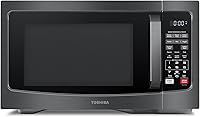
TOSHIBA Countertop Microwave Oven, 1.2 Cu.Ft, 1000W, Black
This Toshiba suits a buyer who wants 1.2 cu ft of capacity, a 20.6 in wide cabinet and sensor-based cooking controls in a black stainless steel finish. Its external dimensions are 20.6 in W x 14.6 in D x 11.8 in H, and it includes a 12.4 in glass turntable.
The smart sensor adjusts cooking time and power based on food humidity. Ten power levels, defrost by weight or time, one-touch starts and preset menus give you more control than a basic timed microwave.
Choose it if you want sensor cooking and a compact width with a black finish. Its 1600 watts of input power means you should check the electrical setup before placing it in a small kitchen.
TOSHIBA Countertop Microwave Oven, 1.2 Cu.Ft, 1000W, Stainless Steel
This stainless steel Toshiba has the same 1.2 cu ft capacity and 20.6 in W x 14.6 in D x 11.8 in H cabinet as the black version. It includes a 12.4 in glass turntable, uses 1000 watts of output power and has 1600 watts of input power.
Its humidity sensor adjusts cooking time and power based on food humidity. Reheat, defrost, cook and boil programs cover common tasks, while the touch controls, clock and kitchen timer keep daily use simple.
Choose this model if the stainless steel finish fits your kitchen better. Because its cabinet dimensions match the black Toshiba, the decision comes down mainly to finish and the specific control program you prefer.
Which small microwave is best for a tighter counter?
The Farberware is the narrowest model here by listed width, measuring 20.2 in W x 16.54 in D x 12.03 in H. Its 1.1 cu ft capacity gives you a compact option, but its depth is greater than the Toshiba models.
Farberware Countertop Microwave Oven 1.1 cu.ft.1000 Watts
This Farberware suits a buyer who wants 1.1 cu ft of capacity, 1000 watts of output and a stainless steel exterior in a compact countertop format. It includes a turntable and user guide, with a clear LED display, kitchen timer and clock.
Ten power levels and multi-stage cooking let you set more than one cooking stage. Six one-touch options include popcorn, potato and pizza, while defrost by weight or time handles frozen food.
Choose it if the 20.2 in width fits your counter better than the Toshiba width. Check depth carefully because the Farberware reaches 16.54 in back from the counter edge.
For a different finish, compare the best small white microwave options. If you want a metal finish and more interior volume, our best small microwave stainless steel guide can help narrow the choice.
What features help with daily cooking?
Prioritize the controls you will use often, not the longest feature list. Sensor cooking can reduce guesswork, while manual power levels give you control for delicate food, defrosting and staged cooking.
A good control layout should be easy to reach and read during normal use. Touch controls and a clear digital display can suit daily cooking, but you should still check that the layout feels simple when you are holding a hot dish.
Look for these practical features:
- Multiple power levels: Useful for defrosting, softening and cooking at lower heat.
- Defrost by weight or time: Gives you two ways to handle frozen food.
- One-touch or express cooking: Helps with short heating tasks.
- A clear display: Makes the remaining time easier to read.
- A kitchen timer: Useful when you need the microwave for another task.
- A removable turntable: Makes routine cleaning easier.
- Mute or ECO settings: Helpful if sound or standby use matters to you.
- Preset menus: Useful for common foods that you cook on repeat.
- A clock: Handy when the microwave sits in a busy kitchen or break room.
- A child safety lock: Useful in homes where a lock helps prevent accidental use.
Sensor features adjust cooking time and power based on food humidity. This can suit reheating and common preset foods, though manual settings still give you a way to adjust for taste and texture.
Defrost by weight suits a full piece of frozen food when you know its weight. Defrost by time gives you more control when you plan to check and turn the food as it thaws.
One-touch and express controls save time on short tasks. They are especially useful for reheating a drink, warming a plate or starting a simple snack without programming a longer cycle.
Multi-stage cooking lets you combine different power levels in one program. That can suit food that needs a softer start followed by full-power cooking, or defrosting followed by cooking.
The Toshiba models add humidity sensing, preset menus and ECO plus mute features. The Farberware offers multi-stage cooking, six one-touch options, express cooking and a child safety lock.
Choose features based on your routine rather than on the longest list. The best controls are the ones you will understand quickly and use every day.
Should you choose a small 1200 watt microwave or a countertop model?
Choose a countertop microwave when you want a simple installation and have a stable, ventilated surface. Countertop models can work well in apartments, offices and kitchens where cabinet installation is not planned.
A countertop model can be placed, moved or replaced without fixing it into cabinetry. This flexibility suits renters, small kitchens and break rooms, and it lets you use the counter space you already have.
If you are replacing an over-the-range unit, use this How to Choose an Over-the-Range Microwave? A Simple Guide before buying a countertop model.
The installation type, ventilation setup and cabinet space are different. An over-the-range unit is made for mounting above a cooktop, while a countertop unit needs its own level surface and clearance.
A small countertop microwave also needs space around the cabinet and in front of the door. Keep the controls reachable, avoid blocking ventilation areas and place the unit on a level surface.
Leave room so the door can open fully without hitting a wall, cabinet or another appliance. You also need enough room to load and remove dishes safely, especially when the food is hot.
Check that the counter can support the weight and that the surface is not exposed to excessive heat or moisture. A sturdy, level spot helps the turntable work properly and keeps the cabinet stable during use.
Ventilation matters for safety and performance. Do not push the microwave tight against a wall or cover the sides and top, and follow the clearance guidance for the model you choose.
Think about outlet access before you set the unit in place. A nearby outlet makes daily use easier and avoids long cords crossing the counter.
A countertop model is often the simpler choice for a small kitchen. It works best when width, depth, height and door clearance all suit the space you have.
How do you choose among these small microwaves?
Pick the black Toshiba if you want 1.2 cu ft, a black stainless steel finish, humidity sensing and a 12.4 in turntable. It suits a buyer who wants sensor-based cooking in a compact countertop cabinet.
Pick the stainless steel Toshiba if you want the same cabinet size and capacity with a stainless steel exterior. The finish is the main difference, so choose the colour that fits your kitchen.
Both Toshiba models have 1000 watts of output and 1600 watts of input power. Check that your outlet and kitchen circuit suit that electrical load before you place either model.
Pick the Farberware if its 20.2 in width helps your counter layout and you prefer 1.1 cu ft with six one-touch options, multi-stage cooking and a child safety lock. Its greater depth makes counter-depth measurement essential.
The Farberware measures 20.2 in W x 16.54 in D x 12.03 in H, while each Toshiba measures 20.6 in W x 14.6 in D x 11.8 in H. A slightly narrower width can help, but the deeper cabinet may reach farther back from the counter edge.
Consider which controls match your habits. Humidity sensing and preset menus may suit hands-off reheating, while multi-stage cooking and one-touch options may suit more manual cooking.
Check turntable space against your everyday dishes before you decide. A 12.4 in turntable gives useful room for round plates, and you should confirm that your largest bowl fits with the door closed.
A 1200 watt output is not automatically the best fit. Match power to your cooking habits, then confirm the cabinet, turntable, electrical load and everyday dish fit before choosing a small microwave.
Frequently asked questions
Is a small 1200 watt microwave better than a 1000 watt model?
A 1200 watt microwave can cook faster, but output is only one part of the decision. A 1000 watt model may fit your counter better, use familiar cooking times and still handle everyday reheating, defrosting and cooking.
Compare cabinet size, capacity and controls before choosing by wattage alone.
What size is a small microwave?
A small microwave usually has a compact outside cabinet and about 1.1 to 1.2 cu ft of interior capacity. Check the exact width, depth and height because two microwaves with similar capacity can need different counter space.
Also measure the turntable and the dishes you use most.
Can a small microwave use 1200 watts?
A small microwave can have high cooking output, but check both output and input power before placing it in your kitchen. The Toshiba models here have 1000 watts of output and 1600 watts of input power.
Your outlet and kitchen circuit must suit the appliance's electrical needs.
What should I check before buying a small microwave?
Measure the counter, overhead clearance, nearby walls and the path to the kitchen. Then compare usable capacity, turntable diameter, power levels, presets, defrost controls, door clearance and cleaning needs.
The smallest cabinet is not useful if your regular bowl or plate does not fit.